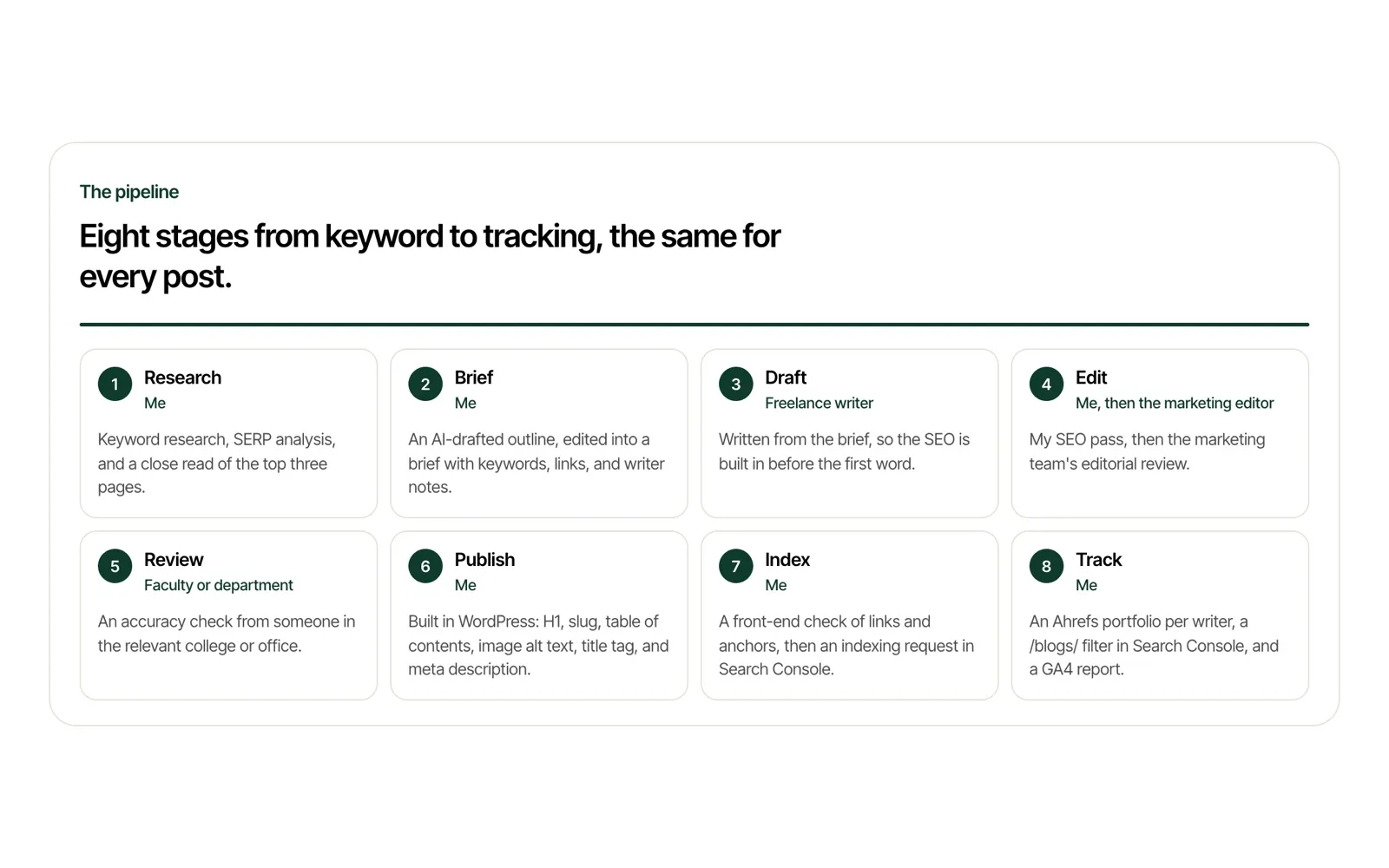
The Furman blog worked because of what went into each post. This page is about the machinery around it. I was the only SEO at Furman, working with two freelance writers, a marketing editor, and faculty reviewers across the university. Strategy alone wasn’t going to publish anything. I needed a process everyone could follow without me in the room.
One pipeline for every post
Every post went through the same eight stages. I wrote them up as a checklist so nothing depended on memory: what to research, who reviews what, how to build the page in WordPress, and how to make sure it gets indexed and measured.
The research and brief stages are where the rankings come from. I’ve written the full method up in How to Write Content That Ranks. The rest of the checklist is about getting a strong brief all the way to a live, indexed, tracked page without anything falling through.
A few of the steps that most checklists skip:
- Request indexing the day a post goes live. Inspecting the URL in Search Console and requesting indexing gets a new post into results faster than waiting for Google to find it.
- Check the page as a reader would. Table-of-contents anchors that jump to the wrong section and broken links are easy to miss in the editor and obvious on the live page.
- Set up tracking before you need it. Each post went into an Ahrefs portfolio, organized by writer, so I
could compare how each writer’s posts performed. Search Console filtered to
/blogs/and a GA4 Explore report covered the rest.
I’ve turned the general version of this checklist into a post: My Blog SEO Checklist, From Brief to Tracking.
Tracking every post
A shared tracking sheet held every post from idea to live URL: the title and category, links to the outline, first draft, and final draft, the writer, the reviewer, approval status, and the published URL. Writers, editors, and reviewers all worked from the same sheet, so anyone could see where a post stood.
The sheet also shows where the work got stuck. In 2023, 21 of 23 planned posts went live. In 2024, writing kept pace but review didn’t: of 31 planned posts, 10 were published. Of the rest, 9 were waiting on a reviewer and 8 were back for edits.
Faculty review was worth it. It’s what made the content accurate, and accuracy is what Google and AI answers reward. But it takes real time from busy people. If I set it up again, I’d plan for that from day one: agree on a review window with each department before assigning their topics, and batch reviews so each reviewer sees a few posts at once instead of a steady trickle.
Teaching the team to do SEO without me
One SEO can’t touch every page a university publishes. So I wrote short guides that let other people get the basics right on their own:
- A blog SEO cheat sheet for writers. One page: choose a target keyword and where to use it (slug, title
tag, meta description, H1, first paragraph), write a meta description that earns the click, break up the
page with subheads and images, and link in and out. It included a shortcut for finding internal links: a
site:search for your keyword on your own domain. - A 10-step WordPress tutorial for anyone building a post: start from the outline, write an H1 with the keyword, use a short evergreen permalink (no years), never change a permalink after publishing, format with a real heading hierarchy, add links and alt text, and fill in the title tag and meta description.
- Five SEO tips for news content for the news team. News stories don’t usually live on search traffic, so this one was about staying findable and evergreen: a target keyword, a strong meta description, subheads and images for skimming, internal and external links, and links back to Furman in press releases to earn backlinks from the outlets that pick them up.
None of the advice is exotic. The point was to make the right thing the easy thing, so pages were built well by default, whoever built them.
A quick-win audit for program pages
Program pages are high-stakes and owned by many departments, so a full rewrite means a long review. I built an audit process to find improvements small enough to make without one: keywords in headings, internal and external links, image alt text, and the title tag and meta description.
For each major page, the process was:
- Export every keyword the page already ranks for from Ahrefs.
- Research the seed keyword (for example, “[program name] major”) for high-volume, low-competition opportunities.
- Pick the best target keyword, then list every place on the page to work it in, along with links and metadata changes.
- Make the changes.
- Add the page’s existing and target keywords to Ahrefs Rank Tracker under a unique tag.
- Record their positions on the day of the changes, then check back at one, three, and six months.
- Feed what worked into the next round of recommendations.
I don’t have the before-and-after numbers from these audits, so I’m sharing the process, not results. The part I’d keep in any version of it is the last three steps: tag the keywords, record a baseline on the day you change the page, and come back on a schedule. Without that, you can’t tell which edits actually moved rankings.