The core work
Every SEO specialist on the team handles three kinds of pages each month:
- Page optimizations: a second look, from a keyword and SEO research standpoint, at a page that already exists, whether it’s a program page, a career guide, or an SEO page.
- New SEO pages: area-of-interest pages built from scratch, like online business degrees, which can surface many related programs.
- Career guides: “how to become a ___” pages.
Each one runs through the same two research stages.
Keyword research. I pick the primary keyword for the page, at least three high-volume secondary keywords that are close variations, and lower-volume keyword variations that say the same thing another way. Then I write the title tag and meta description.
SEO research. I build the page outline from the approved keywords, working them into the headings. I annotate each section in our Drupal component guide: which component it uses, its layout and heading level, and its icons. I also choose the degree programs, blog posts, and internal links to feature, and the FAQs to add. The content team writes the body copy from there.
Then I manage each page through review and launch. I push it live, set annotations in GA4 and Conductor to track performance and rankings, and run an SEO test on optimized pages to compare before and after. I also find relevant existing pages to link to it, so it starts with internal link authority. (The team calls this “juicing.”)
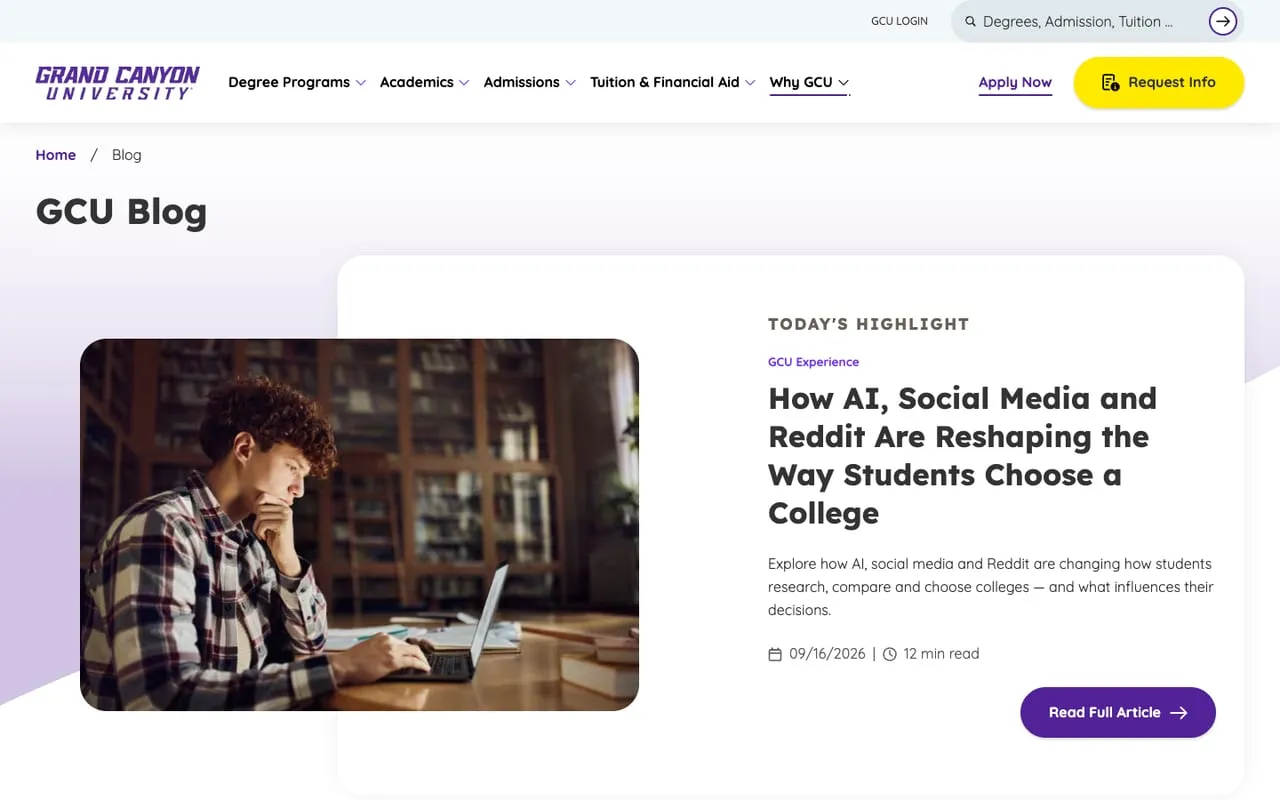
My vertical: the GCU blog
I own the blog. Each month I research about 15 posts: roughly 5 new pieces built around E-E-A-T, and 10 refreshes, one for each of the university’s colleges.
For every post, I:
- come up with the topic
- choose the primary and secondary keywords
- write the page title
- find an emulation link: the top-ranking page we want to beat
- pick a keyword-aligned URL slug
- find internal linking opportunities
- build the outline
The outlines use the same process I built at Furman. I search the primary keyword, export the keyword lists of the top three results, and build an outline that covers the common themes and fills the content gaps.
I also run the blog’s reviews. When a post is written, I check the internal links, the URL slug, and the keyword usage. Once it’s built in Drupal, I do the final QA and test every link on the page.
Results so far
Of the 135 posts I’ve researched, 75 weren’t ranking in August 2025 and are ranking now, drawing about 15,700 estimated monthly organic visits (Ahrefs). The standout posts and full method are in the GCU blog program case study.
My vertical: AI automation and innovation
I build tools that help the team see and work faster:
- A 3D site architecture map of all 1,700 pages on gcu.edu.
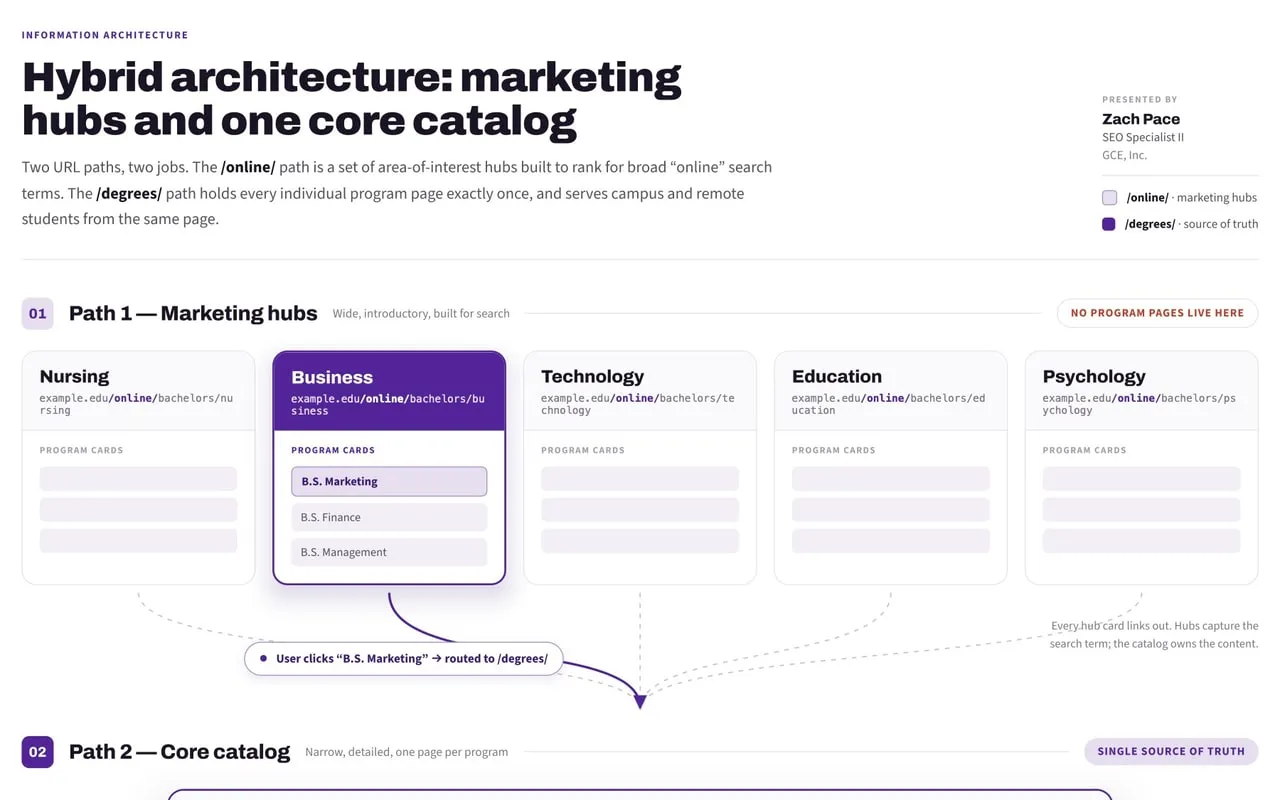
- A site structure analysis showing where the degree program section gets confusing, and a hybrid site architecture I proposed to fix it.
- Custom ChatGPT skills that automate the SEO tasks we repeat day in and day out. I’ve built a library of them, and they make the day-to-day work much faster.
- Project management automation. Our projects have to be updated in both Workamajig and ClickUp, and both systems are staying. I pitched a Zapier budget, got it approved, and am automating the work between them so the team can spend that time on SEO.